Rights for Independent Songwriters
Validating a new rights collection service for underserved songwriters.

Highlights
Outcomes
- Recovered previously unclaimed royalties for the first signed customer
- 68% email open rate on cold outreach to beatmakers (vs ~20% industry average)
- 32% landing page conversion to waitlist (vs 2-5% SaaS average)
- Exceeded signup goal by ~70%
- End-to-end model validated with limited engineering resources
Impact
A new rightsholder segment surfaced
Customer discovery uncovered producers and beatmakers as a large, underserved rightsholder segment. They own real composition rights, but the royalty system consistently fails to pay them.
Real money for a real creator
The first signed customer recovered royalties they otherwise would never have seen. Previously unknown releases became permanent additions to their catalog, continuing to pay out in future distributions.
A repeatable model proven
End-to-end validation demonstrated how ACR-powered rights collection could work for the underserved long tail of independent songwriters.
Background
The opportunity
Huge volumes of music are used across UGC platforms like YouTube, TikTok, and Instagram. Much of that music is covered by blanket licensing, where platforms pay in aggregate rather than per use. It is efficient at scale, but royalties tend to flow toward large, well-registered catalogs, often skipping the independent longtail even though it makes up a significant share of the music actually used.
RME was built to help close that gap. In the near term, that meant using Pex's ACR technology (automated content recognition) to identify where independent compositions were being used, sign rightsholders who were underrepresented by existing systems, and help them claim the royalties they were owed.
At critical mass, RME could become a meaningful counterparty in UGC rights negotiations, advocating for more accurate, usage-based attribution so independent creators are fairly compensated for the use of their music.
What we set out to do
Three goals framed the work: find the right early-adopter segment with clear economic pain that our technology could address; test the demand signal by seeing whether the segment would actually engage and sign up; and prove the recovery model end-to-end, confirming ACR matching could translate into recovered royalties for a real customer.
Role
As Product Lead, I led customer development and research, segment discovery, product validation, and go-to-market execution including a targeted signup campaign.
Customer development
Initial hypothesis: unsigned songwriters
The starting hypothesis was that unsigned independent songwriters were the right first segment to target. The thinking drew on Geoffrey Moore's "crossing the chasm" model: win a narrow, specific niche completely, then use it as an entry point into larger markets.

I ran roughly ten interviews with longtail songwriters, and they broke the original hypothesis. RME's proposition assumed these songwriters were trying to earn from their compositions and losing royalties along the way. Most weren't. They assumed the royalties owed to them were too small to be worth the effort, so collecting them wasn't a priority. The problem RME solved wasn't one they were motivated to fix.
Through these conversations I spotted another segment. Many of these unsigned songwriters were using pre-made beats in their releases, bought from producers on online marketplaces. Within the longtail songwriter tier sat a deeper layer of legitimate composition rights owners: the beatmakers. They sold beats at volume, then lost sight of the released songs built on them. ACR could find those uses by matching the audio itself, sidestepping the unreliable metadata that rights attribution usually depends on.
Producers as the real segment
I led a second round of discovery with about twenty producers and beatmakers. It confirmed the signal: they treated their music as serious business, were hungry for visibility into how their beats were being used, and saw RME as a way to recover money they felt they were owed.
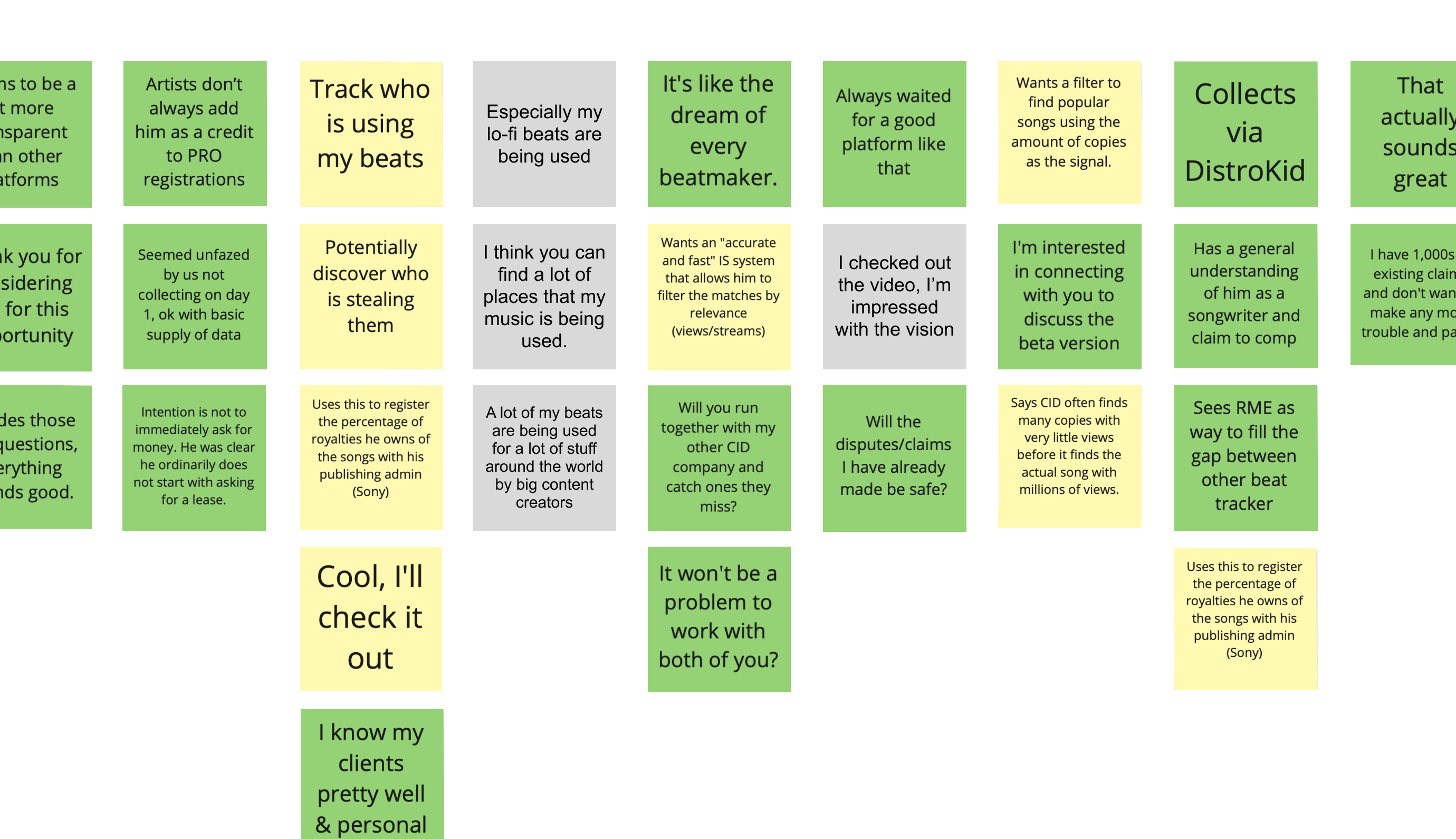
Leading working sessions to distill the findings, I identified three pains that surfaced repeatedly: finding their beats and getting paid for unknown uses, building their brand and presence as producers, and finding collaborators to replicate hit songs. Outreach tested all three. "Finding their beats and getting paid" consistently emerged as the strongest signal. It was also the pain Pex's ACR was uniquely positioned to solve.
Approach
Building the outreach funnel
Discovery had identified the segment. The next step was reaching beatmakers at scale, to test whether real demand existed beyond the twenty discovery conversations. With a bare-bones marketing budget and no dedicated engineering team, I built the outreach pipeline using off-the-shelf tools and our existing pool of proprietary UGC data.
100,000+ leads from an untapped data pool
Without a budget to acquire an audience, I looked to the data Pex already had. Its content-recognition system held billions of scraped UGC videos, gathered to match and identify audio. That same data contained the beatmakers needed for the campaign. Working with the data team, I isolated beatmaker channels scattered across that data and extracted their contact details, producing a list of roughly 100,000 independent beatmakers for the cost of a few queries. A comparable list would have cost tens of thousands from a vendor, if one could be sourced at all.
Crafting the outreach
Insights from the earlier discovery work drove the campaign directly. Landing page and email copy was drafted straight from those conversations, using producers' own words for the pain as the value proposition. To run it, I set up a bulk email vendor with sender authentication and deliverability monitoring, segmented the list, and scheduled the outreach in waves. The campaign A/B tested subject lines and body copy, with open rates monitored and adjusted along the way.
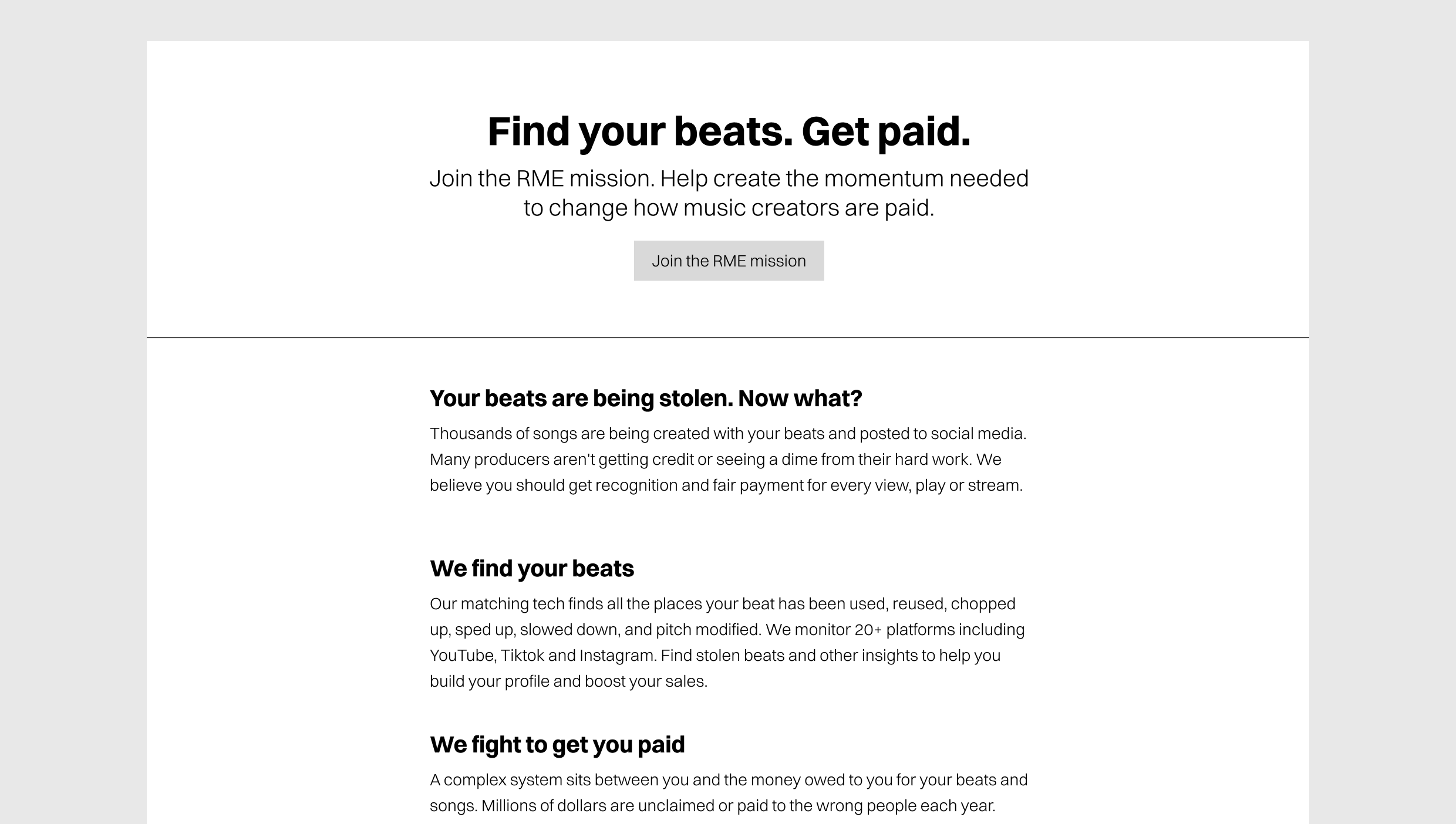
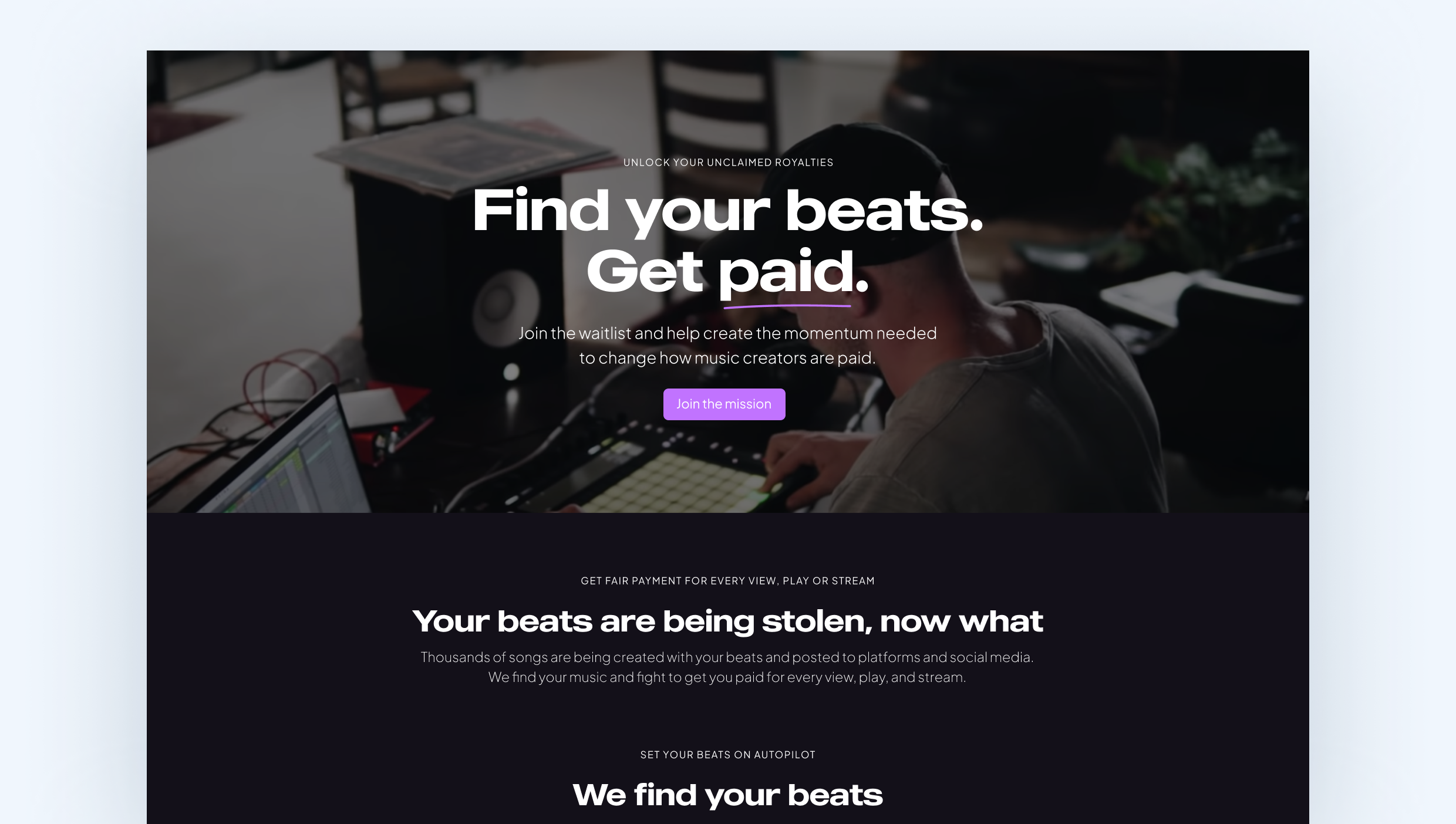


The replies to this cold outreach became one of the richest sources of customer insight in the project. I read and responded to them directly. They surfaced what was resonating, what made people skeptical, and what they wanted the product to do. That was fed straight back into the positioning and copy.
Move fast and fix things
The campaign worked. Signups came in steadily day over day and the inbox filled with replies, a clear sign the messaging was landing. Then mid-campaign, open rates dropped sharply. The bulk email platform was having deliverability problems, with messages landing in spam instead of inboxes. I sourced a new platform, worked directly with their team to understand the setup properly, migrated the pipeline across, and had open rates back within a week.
Results
The campaign performed well above industry benchmarks. Open rates hit 68% against an industry average of ~20%. Landing page conversion to waitlist hit 32% against a SaaS average of 2-5%. The quarterly signup goal was exceeded by roughly 70%. The messaging-market fit was clear. Demand was proven.
“The messaging-market fit was clear. Demand was proven.”
Implementation
Signups proved demand. The next question I had to answer was whether RME could actually recover royalties, proving the model end to end and not just the funnel.
This meant bridging three separate systems: music detection, composition rights data, and MLC registration. With limited engineering resources, I connected them into a single working pipeline, running a beatmaker's catalog through detection to find uses and releases, cross-referencing the MLC to surface unregistered or miscredited songs, and preparing the corrections for a back-office partner to file.
Rather than build software on an unproven model, I delivered this first version as a monthly royalty report, using Snowflake queries and AI-assisted SQL to assemble the findings in Looker. It was lean, and it worked, putting real recovered royalties in front of a rightsholder and giving RME a validated foundation to build on.
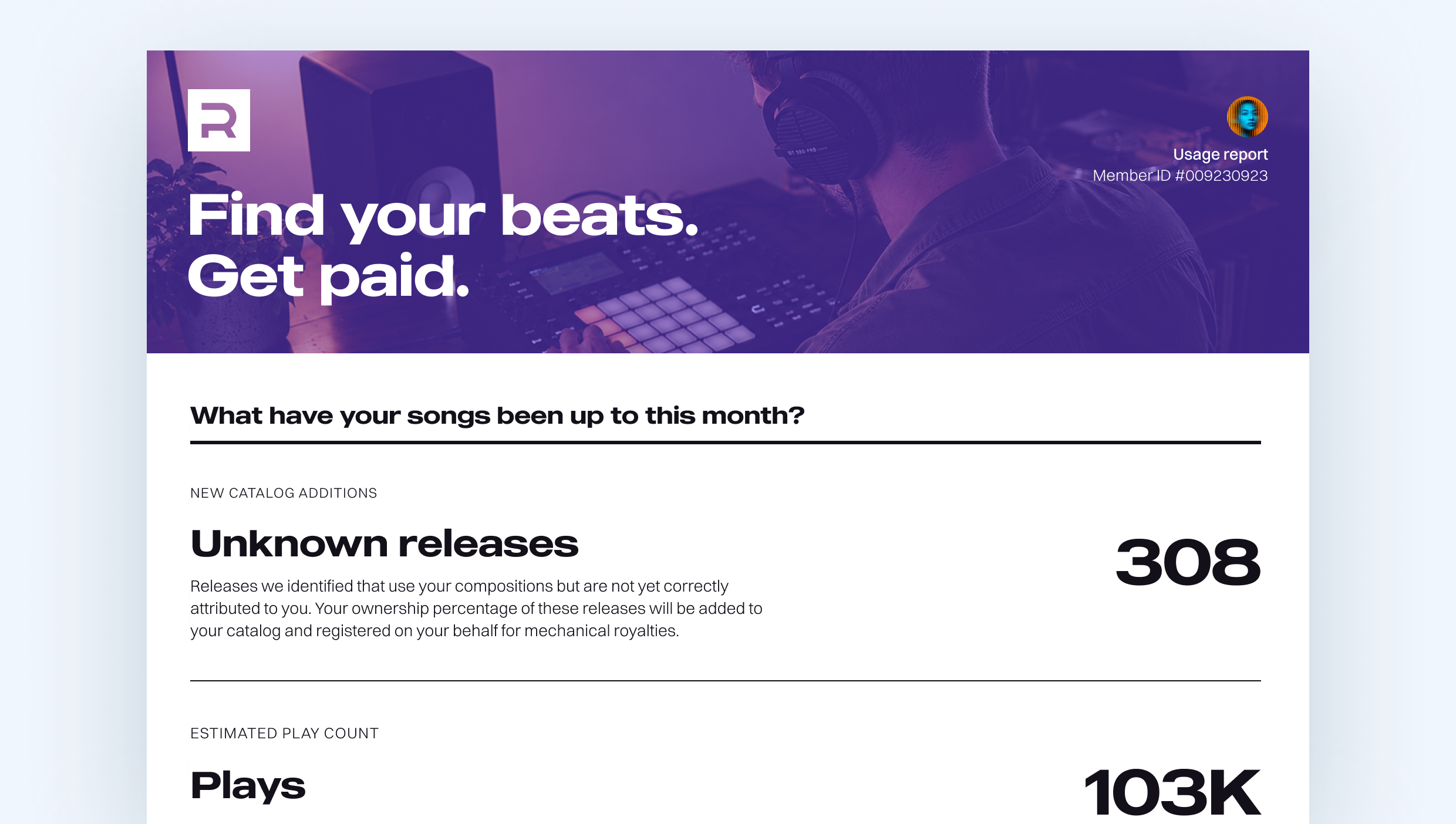

Through this work, the first signed customer, a recognized voice in the beatmaker community, recovered royalties in their first MLC distribution. Those identified releases are now permanent additions to their registered catalog and continue to pay out in subsequent distributions.
Reflection
The pipeline worked. ACR could identify lost royalties at scale, attribute them to the right rightsholder, and convert them into actual recovered money for a real customer.
This gave RME a blueprint for the next phase: scale the beatmaker segment, expand to the next layer of longtail rightsholders, and build toward the critical mass of represented copyright that would put RME in a position to negotiate directly with the platforms.
Bonus content
Alongside the data and funnel work, I wrote and produced a short explainer video to communicate the RME mission. I made it quick and lean on purpose: get the vision in front of people early, take the feedback, refine from there.